
Article 3
Coming soon
Further articles will appear here as they are published.
Insights on construction and energy project delivery — practical leadership, programme control, and transferable capability.
An exploration of transferable project management capability in construction — and why delivery control should be assessed alongside sector familiarity.
Read article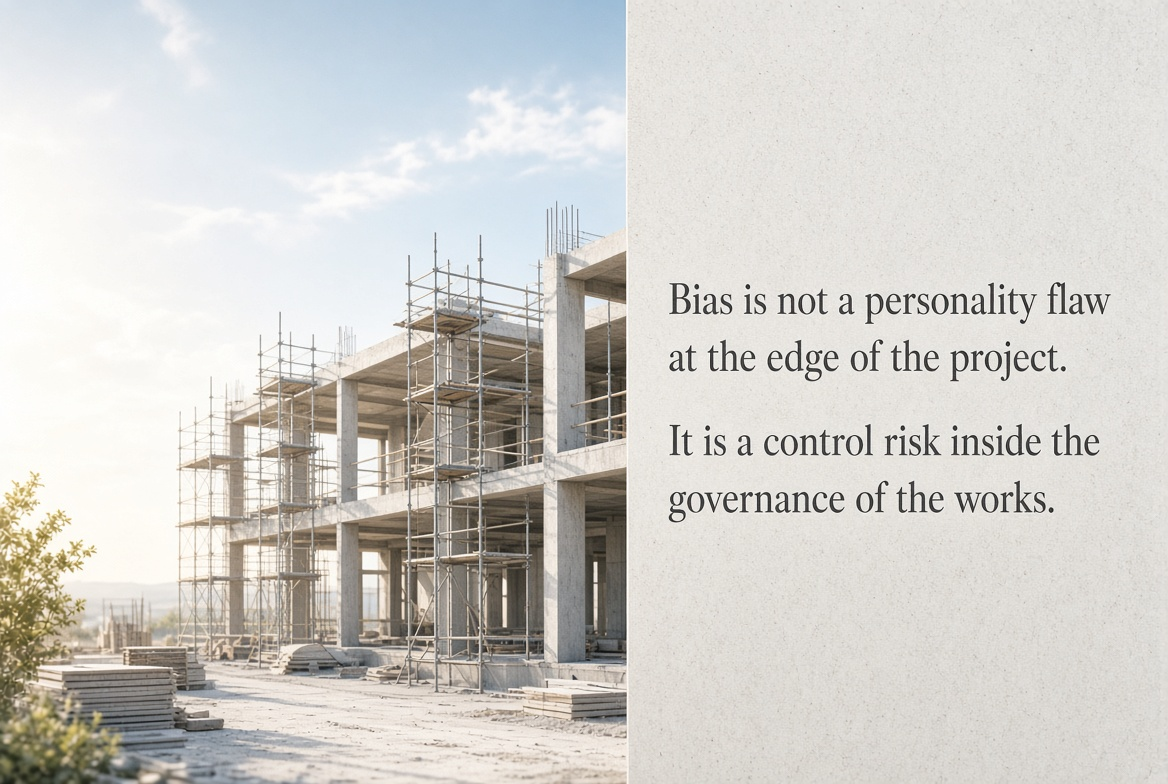
How cognitive bias shapes live project decisions — and why judgement belongs in construction governance.
Read articleArticle 3
Further articles will appear here as they are published.
Article 4
Further articles will appear here as they are published.
Article 5
Further articles will appear here as they are published.
Article 6
Further articles will appear here as they are published.
A noticeable trend has emerged within the construction industry. Job descriptions increasingly rely on narrow sector or project-type requirements as primary filters, even when the underlying capabilities required for successful delivery are broader and more transferable.
The pattern has become more visible as the range of project types has widened. Energy, infrastructure, data centres, industrial process and commercial work now sit in the same market, often using similar delivery models under different labels. As that range has grown, so has the reliance on a previous project type as a shorthand for competence. Shorthand is useful. It is not always a complete measure of whether someone can control the work.
“Proven experience in [specific sector or project type]” has become a common gate, particularly for Project Manager and senior delivery leadership roles. The intention is clear: reduce perceived risk and simplify shortlisting. The effect, however, is that professionals with strong demonstrable delivery experience can be excluded from roles for which they are substantively equipped, simply because their background sits in an adjacent rather than identical setting.
This pattern is visible across the industry — in energy, infrastructure, data centres, process, commercial and industrial construction. It is not limited to any single sub-sector.
Narrow sector familiarity has value. Knowledge of particular technologies, supply chains or regulatory contexts can reduce the time needed to become fully effective. When that familiarity is treated as a hard requirement rather than a preference, the assessment shifts. It begins to measure whether a candidate has previously held a near-identical role, rather than whether they can control the work in front of them.
The capabilities that most consistently determine successful project outcomes are not exclusive to any one project type:
These capabilities are developed most reliably on demanding, multi-discipline projects. They transfer. An approach that does not recognise this, risks overlooking people who already have the operational competence the role requires. The distinction is important. Sector knowledge can tell a project team whether someone has seen a particular technology before. It does not, on its own, tell them whether that individual can hold programme, cost and quality together when interfaces start to move, when a package underperforms, or when a decision has to be made with incomplete information. Those pressures appear on solar farms, process plants, data centres, industrial expansions and major civils schemes alike. The labels differ. The delivery problem is often the same.
The conditions that occupy a Project Manager on a live project are remarkably consistent. An interface that has not been closed. A package that is slipping on the critical path. Change that has not been captured early enough to protect the commercial position. A quality or safety issue that requires an immediate and defensible decision. These are not the property of one sector. They are the ordinary pressures of complex construction. Experience of managing them at scale is a form of operational competence that a project-type label does not describe.
A useful test is to look at the work itself rather than the label attached to it. Enabling works, package interfaces, commissioning readiness, contractor performance, variation control and live-site coordination appear across many project types. Where a professional has already managed those conditions at scale, the transferable value is usually higher than a narrow sector match with less demanding delivery exposure.
When filtering leans heavily on sector labels, two practical consequences follow.
There is a third consequence, less often stated. Projects carry risk at the points where ownership, interfaces and commercial control are weakest. If appointment decisions favour a familiar sector setting over evidence of having held those points before, the project may gain early comfort and lose capability later. Familiarity can shorten the first weeks on site. It does not automatically produce better decisions when the programme comes under pressure.
The issue is not that sector experience is irrelevant. It is that it is sometimes weighted so heavily, that broader evidence of project control is under-valued. A professional who has taken a complex energy or infrastructure scheme through construction, interface management and towards handover may already have solved the problems the next project will present. If the brief only searches for an identical previous setting, that evidence never enters the assessment.
A more precise approach separates preference from requirement.
Sector-specific experience can remain a genuine advantage. In some cases, it is a justified preference. However, it should not automatically outweigh evidence of:
These criteria surface transferable project management capability. Narrow one-line filters can often conceal it.
For clients and delivery organisations, the practical benefit of a clearer test is not generosity toward applicants. It is a better chance of placing competent control on the project. A sector match may reduce perceived induction time. Evidence of ownership, interface management and commercial discipline reduces the likelihood that the project will have to learn those lessons again under pressure.
In practice, transferability can be tested without lowering the standard. A structured conversation can establish whether a candidate has owned live delivery, how they have handled interface risk, how they have protected programme and commercial position, and how they have led teams through demanding phases of work. Those questions reveal operational competence more reliably than a single sector keyword. They also allow sector familiarity to be treated as what it often is: useful context, not the whole test.
The record of a project usually shows where control was real and where it was only nominal. Programme decisions, change control, interface close-out and the handling of underperforming packages leave a clearer trace than a sector title. Where that trace exists, sector familiarity can be weighed as context. Where it does not, a familiar project type is a thin basis for confidence.
This does not mean every adjacent background is automatically suitable. Some roles do require specialist technical knowledge that cannot be acquired quickly. The point is more limited and more practical: where the core requirement is project control, leadership and multi-discipline delivery, those attributes should be assessed directly. Sector experience can then be weighed as an advantage, not used as the only gateway into the conversation.
The construction industry depends on individuals who can take ownership of complex schemes and keep them controlled. As project types continue to diversify — across energy, infrastructure, industrial and commercial sectors — the ability to recognise when experience is transferable becomes more important, not less.
An approach that weighs demonstrable delivery capability alongside sector familiarity, widens the field without lowering the standard. In a market that needs competent project leadership, that distinction remains relevant.
The aim is not to ignore specialist knowledge; it is to ensure that specialist knowledge is not the only evidence considered when the work itself depends on the ability to control a complex project from start to finish.
Construction will continue to need both: people who know a particular sector well, and people who know how to take ownership of demanding work and keep it controlled. The more accurately those two forms of value are distinguished, the more likely it is that the right individual reaches the project.