
Article 3
Coming soon
Further articles will appear here as they are published.
Insights on construction and energy project delivery — practical leadership, programme control, and transferable capability.
An exploration of transferable project management capability in construction — and why delivery control should be assessed alongside sector familiarity.
Read article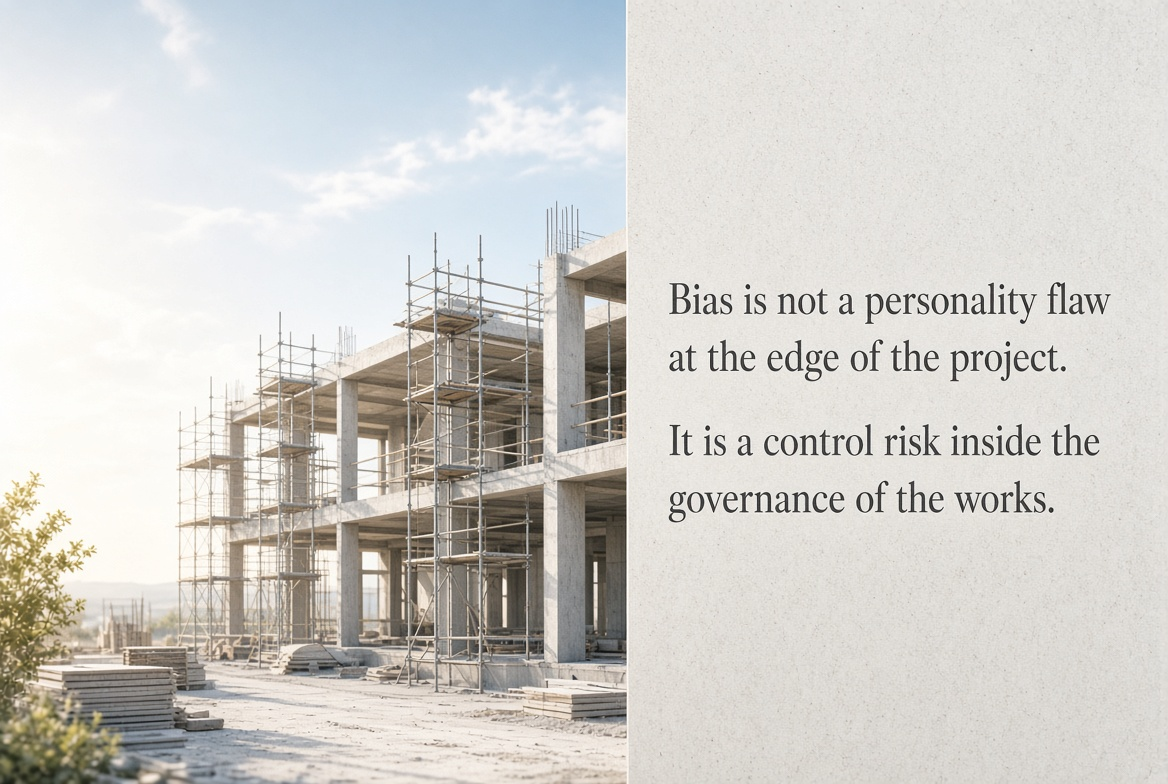
How cognitive bias shapes live project decisions — and why judgement belongs in construction governance.
Read articleArticle 3
Further articles will appear here as they are published.
Article 4
Further articles will appear here as they are published.
Article 5
Further articles will appear here as they are published.
Article 6
Further articles will appear here as they are published.
Construction projects rarely fail only because the Project Execution Plan was wrong. They drift where decisions are made under pressure, with incomplete information, and with interfaces still moving. Optimism about programme, attachment to an early plan, and the tendency to treat the present scheme as unlike any other all shape those decisions. The effect is visible in late change, an unprotected commercial position, and packages that slip without a clear owner.
Technical knowledge does not automatically correct this. A project team can understand the works and still misread the decision in front of it. Decision quality is a governance issue: who owns the choice, what evidence is used, and whether the project can change course before the cost is locked in.
This article examines how cognitive bias appears in live construction control — programme, commercial position and interfaces — and what that implies for team and governance practice. The aim is not to catalogue biases. It is to treat judgement as part of project control, alongside programme, cost, quality and safety.
The conditions that consume attention on a live project are remarkably consistent. An interface that has not been closed. A package that is slipping. Change that has not been captured early enough to protect the commercial position. A quality or safety issue that requires an immediate and defensible decision. None of these is unique to one sector. They appear on energy schemes, industrial expansions, data centres, commercial buildings and major civils works alike.
What differs is not the existence of those pressures. It is the quality of the decisions made under them. Two projects can face the same slipping package and produce two different outcomes. In one, the slippage is named early, the commercial consequence is recorded, and recovery is owned. In the other, the programme is held by assertion, the variation is left for later, and the organisation waits for a clearer picture that never quite arrives. The second pattern is often described as a planning problem or a contractor problem. Frequently it is a decision problem.
Professional bodies have begun to treat this more directly. The eighth edition of the APM Body of Knowledge places greater weight on leadership, judgement and decision-making in volatile, uncertain, complex and ambiguous conditions, and includes judgement and decision-making as a distinct leadership topic (Association for Project Management, 2025). The Institution of Civil Engineers, in its 2025 paper on why major projects cost so much and take so long, identifies short-term decision-making, weak scope definition, and inadequate governance and assurance among the recurring causes of cost and time overrun — not a shortage of method statements (Institution of Civil Engineers, 2025). Recent project management research continues to treat optimism, uniqueness bias and escalation of commitment as recurring features of planning and live control (Cantarelli, 2025; Flyvbjerg et al., 2025). Construction-specific work has also mapped confirmation bias and related decision distortions across health, safety and delivery choices (Purushothaman et al., 2025).
The literature is not scarce. The practical implication is still under-used: bias is not a personality flaw at the edge of the project. It is a control risk inside the governance of the works.
Optimism about programme is the most familiar form. It does not usually present as a wild forecast. It presents as a belief that this week’s lost time will be recovered next week, that the interface will close once the drawings catch up, or that a package will “get going” after the next coordination meeting. Each of those statements can be true in a particular week. The bias is in treating them as a plan. A programme that is held by hope rather than by what the works can actually support is no longer a control document. It is a narrative.
Uniqueness bias works in the same space. Because the present scheme has a particular technology, client or site constraint, historical comparison is set aside. The project is treated as unlike the last one, even where the delivery problem is the same: late design information, a weak package interface, or a commercial position that has not kept pace with the works. Distinctive project labels can reinforce this. The more singular the scheme is made to sound, the easier it is to argue that previous lessons do not apply (Flyvbjerg et al., 2025).
Escalation of commitment appears once an early decision has been defended in public. A sequence, a supplier, a construction method or a completion date becomes difficult to reopen because reopening it would appear as a reversal. The cost of changing course is then weighed against the discomfort of admitting the original assumption has failed. On a live site that delay is rarely free. It is paid in standing resource, in a commercial position that continues to drift, and in a programme that can no longer tell the truth.
Confirmation bias completes the pattern. Information that supports the current story is welcomed. Information that contradicts it is treated as noise, as contractor positioning, or as a problem for another meeting. Reporting then becomes a record of the preferred account rather than a record of the project. Governance paperwork can look complete while the decision quality underneath it is poor.
None of this requires a reckless individual. It requires a competent team operating under incomplete information, with stakeholders who want certainty, and with a programme that is already under pressure. That is the ordinary condition of complex construction. Bias takes hold when the project’s control systems do not slow the decision down enough to test it.
Knowing a particular technology, supply chain or regulatory setting can reduce the time needed to become effective. It does not, on its own, tell an organisation whether the team can hold programme, cost and quality together when the information is incomplete.
A team that has seen a particular plant configuration or building type before may still overestimate recovery, protect an early sequence too long, or leave change unrecorded because the site “will catch up.” Conversely, a team that has not seen that configuration, but has owned slipping packages, interface risk and commercial exposure on other demanding schemes, may read the decision more accurately. Technical familiarity and decision quality are related. They are not the same variable.
This matters, because projects continue to be assembled as if familiarity were a substitute for control. Familiarity can shorten the first weeks. It does not automatically produce better decisions later, when an interface is still open and a completion date has become a political fact rather than a forecast.
A more careful approach does not require a new public method. It requires the controls most schemes already have — programme, change, risk, commercial reporting and coordination — to be used as tests of what the works can actually support, rather than as vehicles for a preferred story.
Ownership still has to be visible. If a package is slipping, the recovery, the commercial consequence and the communication to the client cannot sit as shared concern. A meeting that records the problem without naming the decision required is not control.
The record of the project remains the most reliable check. Programme revisions, instructed change, interface close-out and the handling of underperforming packages leave a clearer trace than a confident progress report. Where that trace exists, judgement can be tested. Where it does not, optimism has nothing to push against. Incomplete information is not a failure of governance. Pretending the information is complete is.
None of this is an argument that judgement replaces technical knowledge. Some decisions cannot be made well without it. A statutory appointment, a tightly regulated technical environment, or a technology with a long learning curve and immediate operational risk still requires people who know that territory. Better decision hygiene does not license bluffing.
The point is more limited. On many appointments the essential demand is the control of a complex project: ownership, interfaces, programme, commercial position and the quality of decisions made when the picture is incomplete. In those cases, specialist knowledge is an advantage. It should not be allowed to hide a weak decision process, and the absence of an identical previous project type should not be allowed to hide a strong one.
A useful test is whether the project can show how a difficult choice was made. What options were considered. What was known and what was not. What was instructed. What residual risk remained. That test works across energy, industrial, commercial and civils schemes. The setting changes. The requirement for a traceable decision does not.
Untested decisions do not stay on paper. They become the conditions under which the rest of the project has to be delivered.
Once a date, a sequence or a commercial position has been defended in public, the organisation starts to work around it. Design is hurried to protect a start that was never ready. Packages are released with open interfaces because the report cannot absorb another amber. Change is left undiscussed because raising it would reopen a decision that has already been sold. None of that is visible as a single failure. It appears as a series of local compromises that, taken together, strip the project of control.
The damage is commercial as well as operational. Variation that is not captured while the works are still fluid is later argued as entitlement. Recovery that was assumed rather than demonstrated arrives as standing time, out-of-sequence working and a completion date that can only be held by compressing everything that follows. Assurance can still look intact, the folders are complete, and the meeting cycle is running; however, the decision underneath has already gone.
There is a further cost inside the team. People closest to the works usually know when the official account has parted company from the site. If governance cannot close that gap, informal workarounds replace formal control. Safety and quality are then carried by individual vigilance rather than by the system. That is not resilience. It is exposure.
The implication is straightforward. Decision quality is not a soft overlay on delivery. It is one of the mechanisms by which programme, cost and safety are either protected or quietly given away. An organisation that treats judgement as part of governance still faces uncertainty. It does not convert that uncertainty, unexamined, into a commitment the works cannot keep.
Construction depends on organisations that can take ownership of complex work and keep it controlled. Programme, cost, quality and safety remain the visible measures. Underneath them sits a less visible one: the quality of the decisions made when information is incomplete and interfaces are still moving.
Cognitive bias is not an exotic explanation for failure. It is a practical description of how capable teams overestimate recovery, protect an early plan too long, and treat the present scheme as unlike any other. Technical familiarity does not automatically correct that. Control systems that force the project to look at its own record can.
A more careful approach does not require a new professional language. It requires visible ownership of the decision, evidence separated from narrative, and reporting that tells the truth about uncertainty. Those requirements belong in project governance in the same way that programme and commercial management already do.
Construction will continue to need technical knowledge. It will also continue to need teams and governance arrangements that can decide well under pressure. Distinguishing those two requirements is what keeps a project under control when the information is still incomplete. Where they are treated as the same thing, control is assumed rather than demonstrated.
Association for Project Management. (2025). APM body of knowledge (8th ed.). https://www.apm.org.uk/book-shop/apm-body-of-knowledge-8th-edition/
Cantarelli, C. C. (2025). Kahneman’s legacy in project management: Improving decision-making and performance. International Journal of Project Management, 43(4), Article 102697. https://doi.org/10.1016/j.ijproman.2025.102697
Flyvbjerg, B., Budzier, A., Christodoulou, M. D., & Zottoli, M. (2025). The uniqueness trap. Harvard Business Review, 103(2), 118. https://hbr.org/2025/03/the-uniqueness-trap
Institution of Civil Engineers. (2025). Why do major projects cost so much and take so long? And what can be done about it? https://www.ice.org.uk/media/i3ljrxo5/2707ice_mmc_report_a4_layout_v3_web.pdf
Purushothaman, M. B., Jessica, P., & Rotimi, F. E. (2025). Analysis of cognitive biases in construction health and safety in New Zealand. Buildings, 15(7), Article 1033. https://doi.org/10.3390/buildings15071033